 The following legal decisions concern the law of self-defense. Some of the rulings are final and others are not. They’re presented here, along with salient excerpts, to be read for their excellent judicial logic about the absolute civil right of armed self-defense as established by the framers of the US Constitution.
[ Read the SemperVerus article, USA State Constitutions Providing for Armed Self-Defense ]
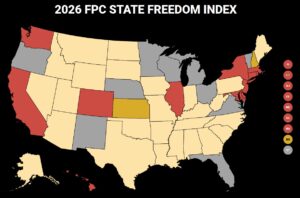 Also see the Firearms Policy Coalition Interactive State Freedom Index Map, which ranks the percentage of Second Amendment freedom citizens have in each of the 50 states and Washington, DC for the unencumbered civil right to keep and bear arms (only Kansas and New Hampshire earn a perfect 100% score).
US Supreme Court Justice Clarence Thomas agreeing to the denial of certiorari but issuing a separate statement in: Novotny v. Moore, Petition for Writ of Certiorari to the US Court of Appeals for the Fourth Circuit, No. 25–1324 (November 16, 2026) (pdf pages 1-4).
“Maryland is one of several States that prohibit law-abiding gun owners from carrying firearms in a wide variety of public places. Under Maryland law, an individual may not carry a firearm in public demonstrations, mass transit, places of amusement, healthcare facilities, locations that sell alcohol for onsite consumption, and tens of thousands of acres of state park and forest land. I am skeptical that each of these laws is consistent with this Nation’s historical tradition of firearm regulation in sensitive places.”
“The Second Amendment recognizes the people’s inherent right to keep and bear firearms, a right that admits of only historically grounded exceptions. Before and after the founding [of the USA], it was well understood that individuals enjoyed a natural right to keep and bear arms, which included the right to carry firearms in public spaces for self-defense. The Constitution codified [that] pre-existing right.”
“[T]he historical record yields relatively few 18th- and 19th-century sensitive places where weapons were altogether prohibited.”
“[State laws that expand the category of sensitive places] stand on questionable historical ground. And, their cumulative effect is to prohibit firearms wherever people gather for eating, drinking, recreation, amusement, and free speech—an affront to the right of law-abiding citizens to carry arms in public for their ordinary self-defense.”
I harbor serious doubts that our Nation’s historical tradition of firearm regulation supports many of these sweeping restrictions. In an appropriate case, this Court should consider whether particular sensitive-place laws are consistent with the right to public carry. * and *
US District Court Western District of New York ruling: Heeter v. James (October 21, 2026) by US District Judge John L. Sinatra Jr. (pdf).
This 47-page ruling says New York’s body armor ban violates the Second Amendment, holding that body armor is an ‘Arm’ protected by the Second Amendment’s plain text.
“Indeed, body armor is an ‘Arm’ protected by the plain text of the Second Amendment. As such, regulation in this area is permissible only if the State demonstrates that the new enactment is consistent with the Nation’s historical tradition of sufficiently analogous regulations. New York fails that test.”
“In Heller, the Supreme Court….also addressed the definition of ‘Arms.’ Concluding that ‘[t]he 18th-century meaning is no different from the meaning today[,]’ the Court explained ‘[t]he 1773 edition of Samuel Johnson’s dictionary defined ‘arms’ as ‘[w]eapons of offence, or armour of defence.’….The Second Amendment’s meaning is strongly confirmed by its historical background.”
“The dictionary definitions relied upon in Heller confirm that ordinary citizens at the founding understood the term ‘arms’ to include defensive body armor.”
“The defensive body armor available today is no more exempt from the Second Amendment’s protections, simply because [it was] unknown to the First Congress, than electronic communications are exempt from the First Amendment, or electronic imaging devices are exempt from the Fourth Amendment.”
“Indeed, Plaintiffs have adduced reliable evidence that body armor is in common use today. Plaintiffs’ calculations, supported by market reports, conservatively estimate that more 82,000 units of body armor were purchased in 2023, more than 87,000 were purchased in 2024, and more than 93,000 units were purchased in 2025….In addition to market research evidence, the fact that 49 states do not ban body armor suggests that it is jurisdictionally common as well.”
“The Constitution requires that individuals be permitted to use arms—including body armor—for the core lawful purpose of self-defense. Nothing in the Nation’s history or traditions closes the door on that right by permitting a categorical ban on the purchase and sale of a specific type of arm.” * and *
[ Read the SemperVerus article, Discreet Body Armor for Self-Defense and Church Security ]
US Court of Appeals for the Fifth Circuit ruling: Knife Rights, Inc. v. Blanche (October 21, 2026) by Chief Judge Jennifer Walker Elrod (pdf).
This 27-page unanimous ruling says Section 1242 of the Federal Switchblade Act (FSA), which restricts the interstate introduction, manufacture, transportation, and distribution of automatically opening knives (switchblade knives), violates the Second Amendment and is unconstitutional.
“We determine that switchblade knives qualify as ‘Arms’ and are covered by the ‘plain text’ of the Second Amendment.”
“…the plain text of the Second Amendment covers the conduct at issue because switchblades are arms commonly used for defense and manufacturing and procuring them facilitates using them for defense.”
“Amongst other definitions, Heller highlighted that the founding era understood the term [arms] to mean ‘any thing that a man wears for his defence, or takes into his hands, or useth in wrath to cast at or strike another.’ (quoting Arms, A New and Complete Law Dictionary (2d ed. 1771). Switchblade knives have surely been used for ‘defence’ and to ‘strike another.’”
“Knives have been used for defense throughout human history, including the American founding….In short, some forms of switchblades have been commonly used for defense for hundreds of years. They are ‘arms.’ Accordingly, the government’s not-in-common-use argument fails. In addition to the wealth of history indicating the founding-era uses of switchblades for defense, the record indicates that there are ‘millions’ of automatically opening knives in the United States now.”
“…there are ‘lawful purposes including self-defense, target shooting, hunting, and pest control’); Letter from Deputy Attorney General William P. Rogers to Representative Oren Harris (April. 12, 1957), (stating that the switchblade ‘is not inherently dangerous but requires the introduction of a wrongful human element to make it so’).” *

 Findings from the Crime Prevention Research Center (CPRC) show that 94% of mass shootings over a 69-year period occurred in “gun-free zones,” locations where signs are posted stating weapons are not allowed to be carried on the property, which only responsible law-abiding citizens abide by and criminals see as magnets for their murderous intent since they know their killing will go unchallenged.